
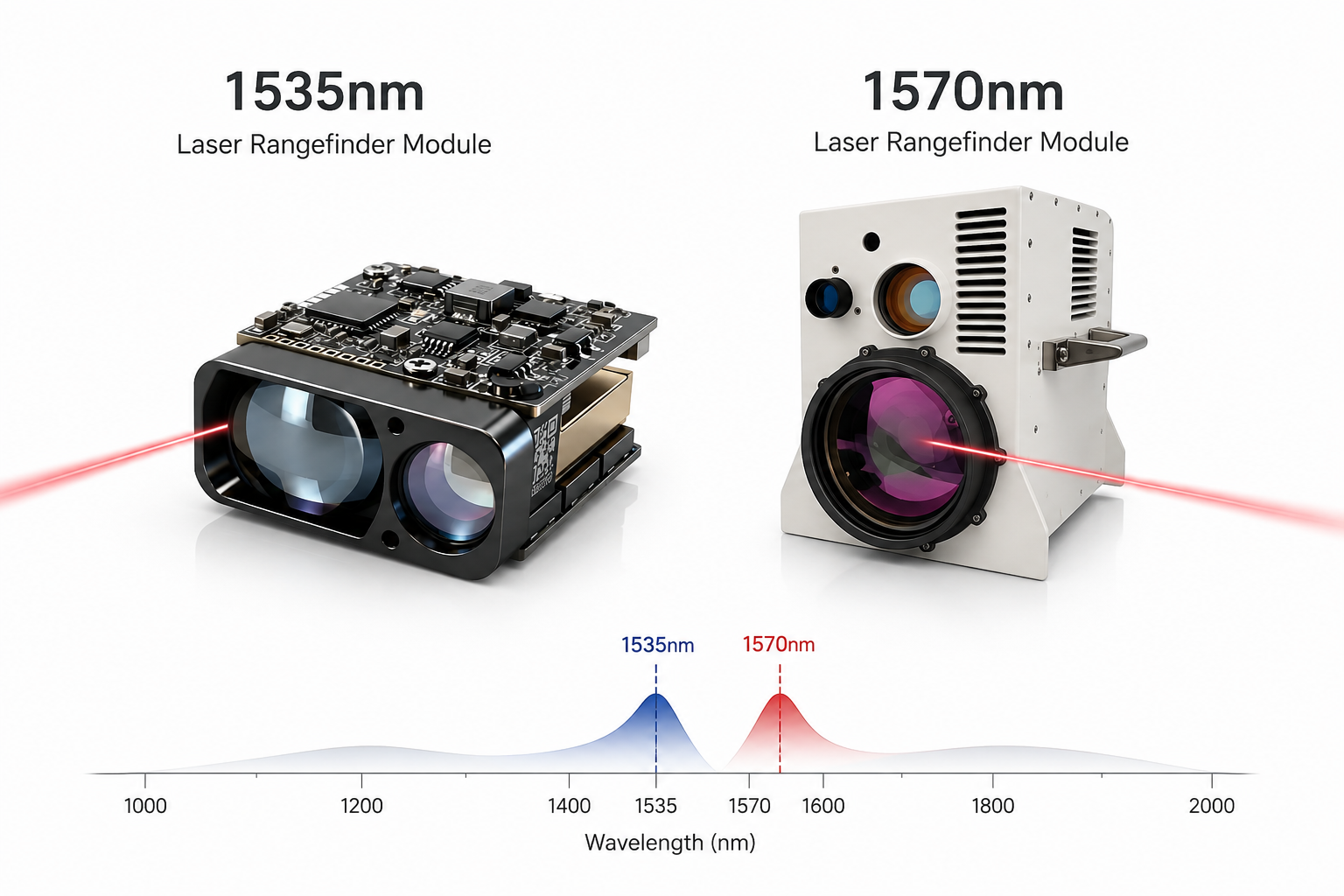
Eye-safe short-wave infrared (SWIR) laser ranging modules have become mainstream solutions for long-distance distance measurement. Among them, 1535nm and 1570nm laser rangefinder modules are two widely adopted wavelength options. Both fall into the 1400–1600nm retina-safe spectrum conforming to IEC 60825-1, yet they show obvious divergence in atmospheric transmission characteristics, laser implementation, signal attenuation, cost and applicable scenarios.
If you are selecting laser ranging sensors for UAV electro-optical pods, border perimeter surveillance, long-range observation systems, marine monitoring and industrial LiDAR, understanding the differences between 1535nm and 1570nm modules is essential to avoid mismatching hardware to operating environments.
1. Fundamental Spectral & Atmospheric Transmission Difference
Atmospheric water vapor and aerosols are the key factors affecting laser propagation.
| 1535nm Laser Ranging Module | 1570nm Laser Ranging Module |
| 1535nm sits inside a relatively low-absorption atmospheric transmission window for SWIR. Water vapor absorption loss is moderate under normal humidity conditions. Under clear weather, light haze and light rain, signal attenuation is lower. The wavelength matches mature erbium glass laser technology, forming a stable industrial technical route. | 1570nm is closer to the strong water vapor absorption band. In high humidity, heavy fog and coastal marine environments, atmospheric absorption will bring greater signal loss. However, in dry inland, low-humidity plateau environments, the transmission performance gap between 1570nm and 1535nm shrinks significantly. |
1535nm has better all-weather adaptability, especially humid and coastal regions; 1570nm performs acceptably under dry atmospheric conditions.
2. Laser Light Source & Hardware Implementation
| 1535nm Laser Ranging Module | 1570nm Laser Ranging Module |
| Mature mass production supply chain | Flexible wavelength tuning capability |
| Stable pulse energy, low temperature drift | Narrower spectral linewidth for stronger anti-interference against background light |
| Easy miniaturization for lightweight UAV payloads | |
| Well-matched commercial InGaAs receiving detectors |
3. Eye Safety Standard
Both wavelengths belong to eye-safe bands above 1400nm. Laser energy is mainly absorbed by the cornea and lens, hardly reaching the retina. Both can achieve Class 1 / Class 1M certification under IEC60825.
Practically, the maximum permissible exposure (MPE) value is slightly different. When designing ultra-long-range modules that require high single-pulse energy, engineers need to recalculate safety parameters according to exact wavelength.
4. Detection Range, Accuracy & Weather Adaptability
- Clear atmosphere: The maximum effective ranging distance of 1535nm is slightly longer than 1570nm.
- Humid, foggy, coastal scenarios: The performance gap expands. 1570nm suffers more severe attenuation, leading to shorter detectable range and higher false failure rate.
- Dry inland, plateau, low vapor environments: The ranging capability of two wavelengths is comparable.
5. Cost, Volume & Integration Ability
| 1535nm Laser Ranging Module | 1570nm Laser Ranging Module |
| Favored by system integrators for drone pods and vehicle-mounted PTZ. Miniature lightweight versions are widely available. Stable supply helps control overall project cost. | More commonly seen in customized special optical systems. Standard small-size products are fewer. Generally higher procurement cost compared with equivalent-range 1535nm modules. |
6. Recommended Application Scenarios
| 1535nm Laser Ranging Module | 1570nm Laser Ranging Module |
| UAV electro-optical payloads, lightweight airborne ranging | Dry inland, plateau low-humidity operating conditions |
| Coastal border defense, maritime monitoring, high humidity working environment | Special optical systems requiring specific narrow wavelength spectrum |
| General long-distance perimeter security, outdoor all-day observation | Customized optical path design with strict spectral filtering requirements |
| Mass integration projects with strict budget and volume limits | Projects that need to avoid mutual interference with existing 1535nm optical equipment |
Conclusion
There is no absolute "better" between 1535nm and 1570nm laser ranging modules.
For most commercial and industrial long-distance ranging projects, 1535nm modules deliver balanced all-weather performance, mature supply and miniaturization advantages, becoming the mainstream choice.
1570nm is a targeted alternative, suitable for dry environments and customized optical systems with special spectral requirements.
Before finalizing your design, we suggest conducting field testing based on the actual humidity, fog frequency and target distance of your deployment area.