
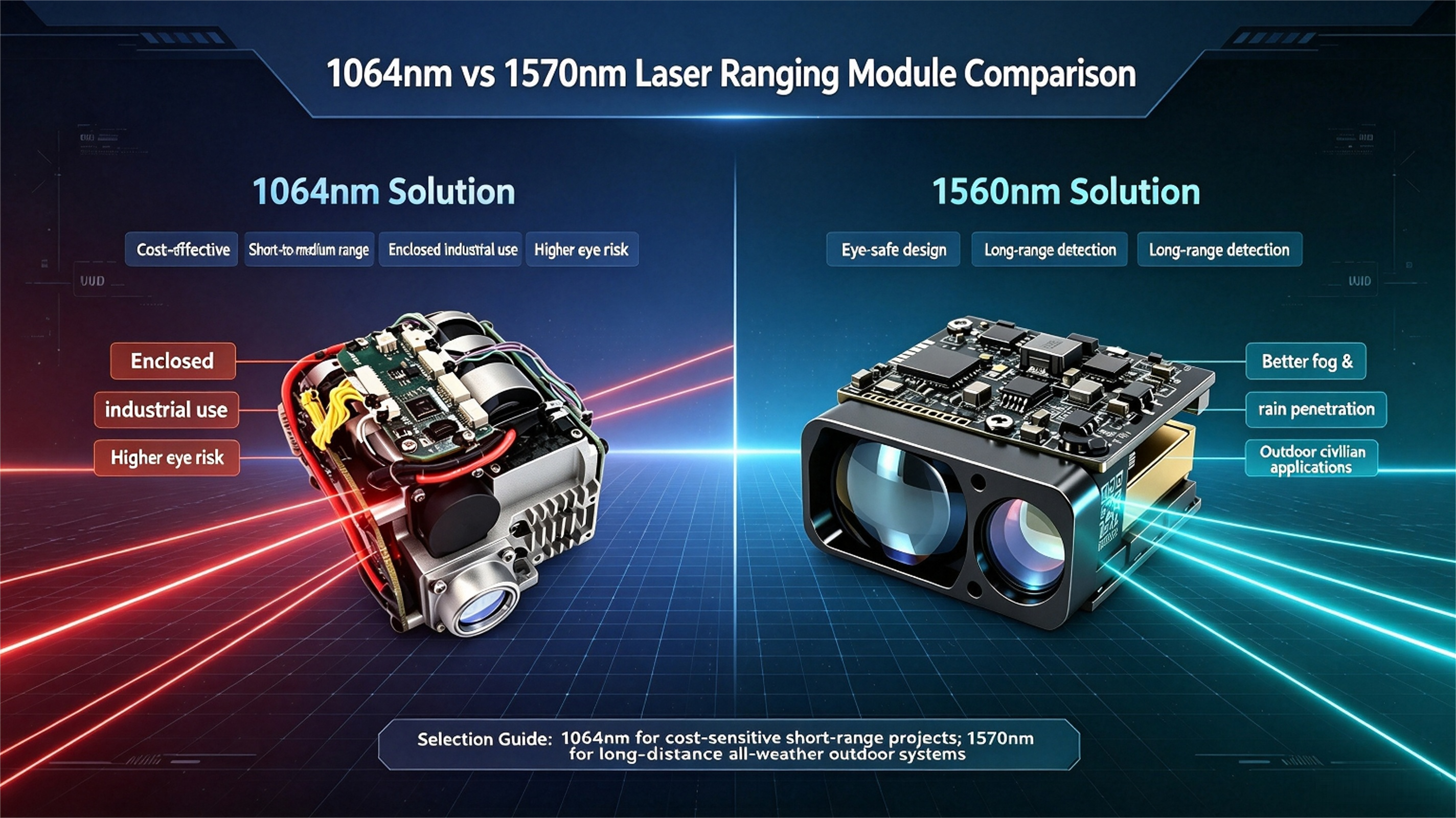
1570nm and 1064nm are the most common infrared laser wavelengths for laser distance measurement and LiDAR sensing. Both laser ranging modules deliver high-precision non-contact distance detection, while they differ greatly in eye safety, weather adaptability, detection range and application scenarios.
The 1064nm laser ranging module features mature technology, complete supply chain and cost-effective performance. With stable photoelectric conversion efficiency, it performs excellent in short and medium-distance ranging under clear weather conditions. However, 1064nm laser can penetrate the cornea and focus on the human retina, bringing higher eye damage risks. Limited by eye safety standards, its transmit power and maximum ranging distance are restricted. It is widely used in industrial automation, professional surveying and mapping, and enclosed industrial or military ranging scenarios.
The 1570nm laser ranging module is a mainstream eye-safe solution for civilian outdoor applications. Most 1570nm laser energy is absorbed by the human eye’s cornea and lens, which cannot reach the retina. It allows higher pulse emission energy under safety certification, supporting longer detection distance and stronger signal stability. Compared with 1064nm, the 1570nm module has lower atmospheric attenuation, better penetration in fog, rain and haze weather, and stronger anti-sunlight interference capability, ensuring stable all-weather ranging performance. It is ideal for autonomous driving LiDAR, UAV obstacle avoidance, construction machinery anti-collision, outdoor security monitoring and open-area industrial detection scenarios.
In short, 1064nm modules are the preferred choice for cost-sensitive, short-medium distance and indoor enclosed industrial measurement. 1570nm modules are the optimal solution for long-distance, all-weather outdoor and human-contact civilian ranging projects.