
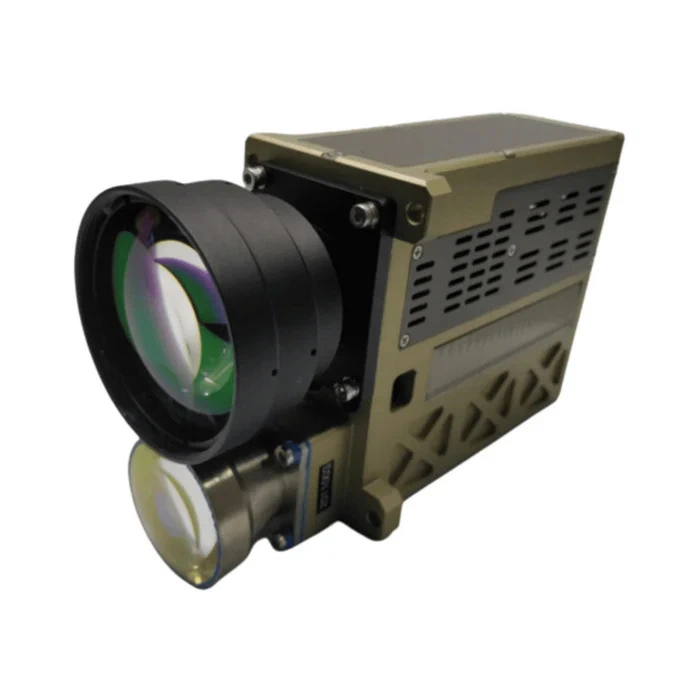
The 1570nm wavelength band has become the preferred choice for laser ranging modules due to its eye-safety compliance and strong resistance to atmospheric attenuation. Optical Parametric Oscillator (OPO) technology enables the precise output of this wavelength, with the stability of the optical system directly determining ranging accuracy and environmental adaptability. Constructing a highly stable optical path requires breakthroughs in three key areas: light source matching, optical path optimization, and interference-resistant design.
Regarding light source selection, a diode-pumped Nd:YAG laser serves as the pump source, paired with a LiNbO3 crystal OPO resonant cavity. Closed-loop temperature control limits crystal operating temperature fluctuations to within ±0.1°C, thereby minimizing the impact of wavelength drift on ranging accuracy. Additionally, a collimating lens and a narrowband filter are installed at the OPO output to eliminate stray light and ensure the monochromaticity and directionality of the 1570nm laser beam.
The optical path design prioritizes miniaturization and vibration resistance. Optical components—such as mirrors and beam expanders—are secured using integrated metal mounts, with silicone shock-absorbing pads placed between the mounts and the module housing to mitigate optical path misalignment caused by mechanical vibration. A folded optical layout is employed to shorten the optical path, while a three-point positioning method secures the components to maintain coaxial alignment during long-term operation.
To further enhance stability, an adaptive compensation module is incorporated into the optical path. A photodetector monitors beam misalignment in real-time, and a micro-piezoelectric actuator dynamically adjusts mirror angles to compensate for errors induced by temperature fluctuations and vibrations. Furthermore, the optical cavity features a sealed design with internal desiccant and nitrogen filling; this protects optical components from humidity and dust, thereby improving the module's operational stability in complex environments.