
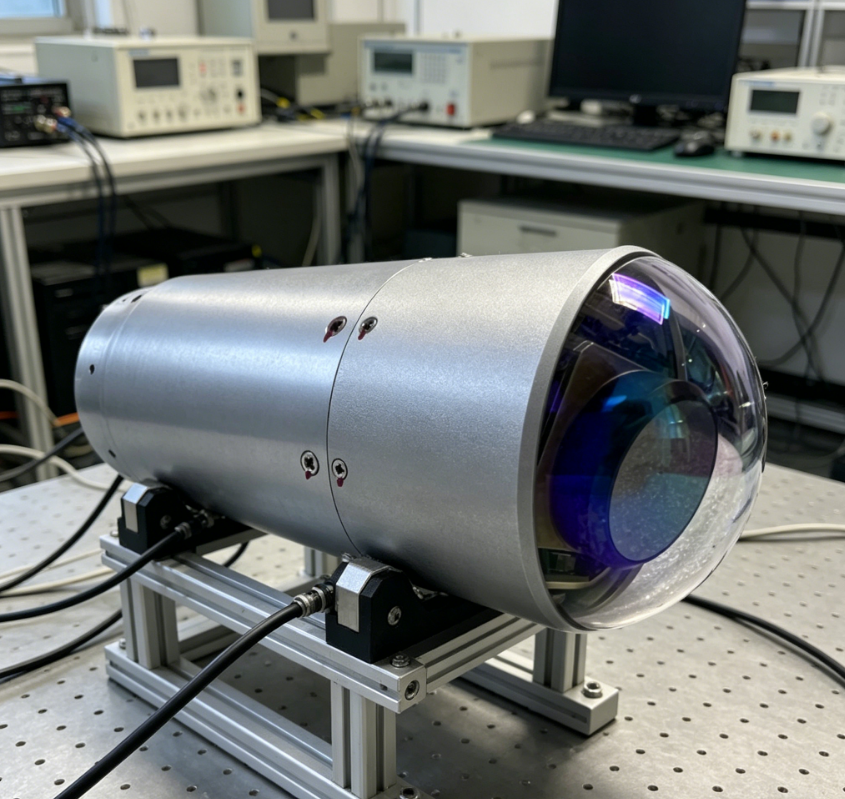
Laser strapdown seekers and laser tracking seekers represent the two dominant approaches in laser guidance technology; their fundamental distinction lies in their line-of-sight stabilization mechanisms, which in turn influences their structural design, performance characteristics, and application scenarios.
In terms of fundamental principles, a strapdown system—a type of non-mechanical stabilization platform—directly rigidly mounts the detector to the missile body; it relies on an inertial navigation system to capture the missile's attitude and employs algorithms to perform coordinate transformations and error compensation, thereby achieving line-of-sight stabilization through software correction. In contrast, a tracking system utilizes a precision mechanical stabilization platform, mounting the optical system and detector independently; it employs gyroscopes to sense the missile's angular motion, while servo mechanisms drive the platform to move in the opposite direction, thereby ensuring the stability of the optical axis through physical isolation.
In terms of structure and performance, strapdown systems feature a simple design, compact size, and light weight; they possess strong overload resistance, rapid response speeds, and lower costs. However, their angular measurement accuracy is constrained by the algorithms and the performance of the inertial navigation system, and they exhibit relatively weak resistance to clutter interference. Tracking systems, conversely, involve complex mechanical structures, are heavier, and have limited overload resistance and somewhat slower dynamic response times, resulting in higher maintenance costs. Nevertheless, they offer stability accuracy on the microradian scale, outstanding interference immunity, and a high level of technological maturity.
Each system is suited to specific application scenarios: strapdown systems are predominantly utilized in short-range, high-speed strike weapons—such as small missiles and guided artillery shells—while tracking systems dominate the realm of medium-to-long-range precision strike assets, including laser-guided bombs and large air-to-ground missiles. These two approaches are complementary, working in tandem to support the diverse requirements of the laser-guided weapon ecosystem.