
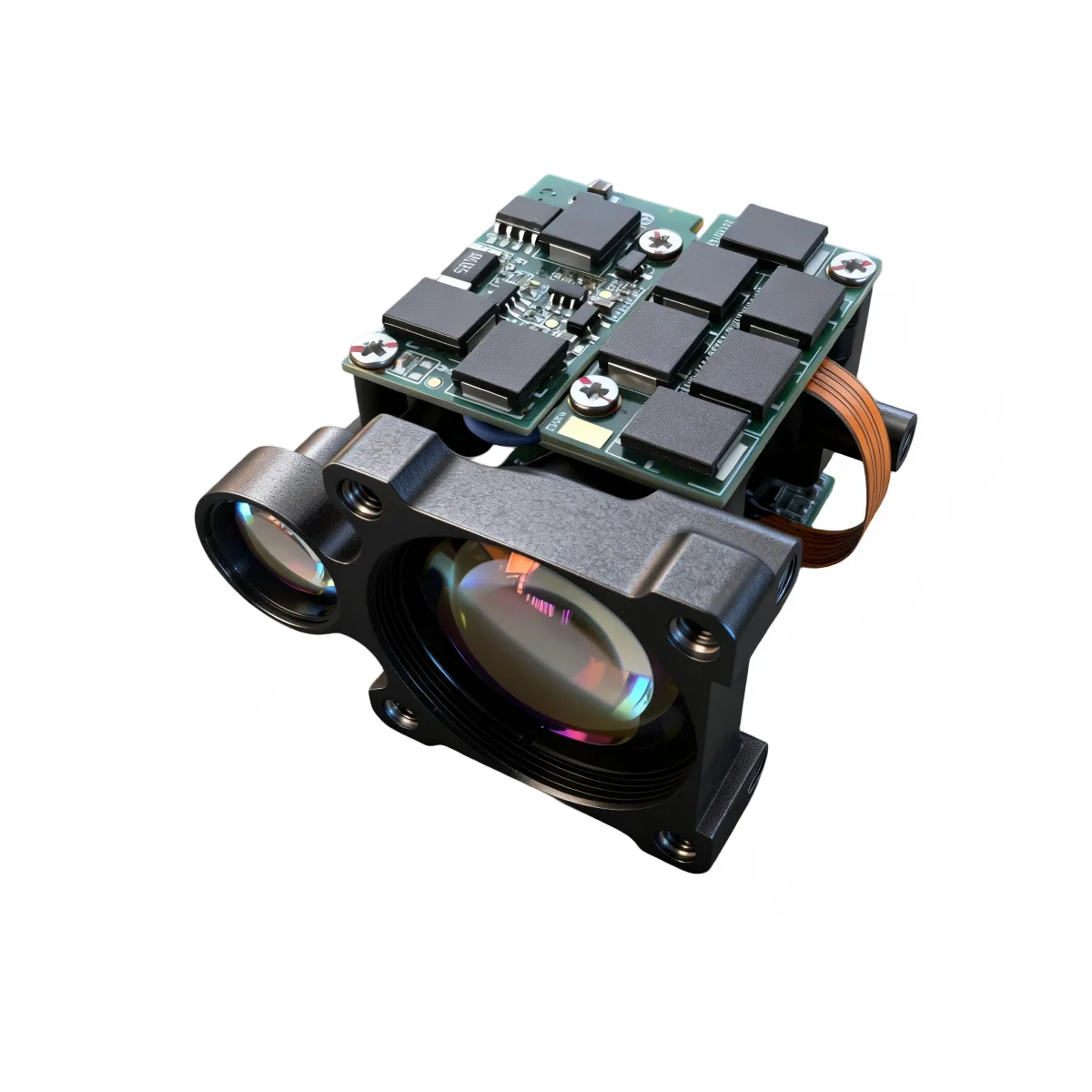
Infrared thermal imaging, unaffected by light and capable of penetrating complex environments, is a crucial pillar of infrared ranging technology. It utilizes infrared thermal imaging to detect the infrared radiation emitted by objects, producing infrared images. Ranging is then performed using principles such as triangulation and time-of-flight methods, and has wide-ranging and irreplaceable applications. Militarily, infrared thermal imaging ranging is a vital battlefield tool. For example, thermal imaging ranging systems on tanks and aircraft can accurately detect targets several kilometers away in darkness, smoke, or dust storms. Its advantages include no signal transmission required, strong concealment, and the ability to avoid interfering with enemy reconnaissance systems. Furthermore, it can distinguish between camouflaged and effective targets by utilizing differences in thermal radiation. Ranging errors are within the meter range, essential for precise target engagement.
Industrial Scenarios
In industrial settings, infrared thermal imaging ranging can solve complex measurement environment problems. For example, in high-temperature smelting workshops, traditional rangefinders are prone to failure due to baking effects. Infrared thermal imaging rangefinders can be used to measure distances in environments far from high temperatures, such as the distance between equipment in the furnace and the height of heated materials. During power line inspections, it can also measure the distance between power lines and pole heights through fog, snow, and rain, while simultaneously measuring the thermal fault status of equipment, enabling simultaneous ranging and fault detection.
In security and civilian applications
Infrared thermal imaging rangefinders have new applications. For instance, intelligent security equipment equipped with infrared thermal imaging rangefinders can accurately measure the distance between intruders and the camera in the absence of light, and can be linked with alarm systems to achieve alarm classification. In autonomous driving, infrared thermal imaging rangefinders can be combined with lidar and cameras to identify pedestrians in rain and snow, calculate safe driving distances, and improve vehicle safety. Furthermore, in the exploration industry, it can penetrate trees to identify obstructions, measure terrain differences and geological coverage areas, and provide sampling for wireline surveying.
Currently, infrared thermal imaging ranging technology is becoming increasingly miniaturized and precise. Thanks to advancements in chip technology, portable rangefinders now weigh less than a few hundred grams and have a ranging range of tens of kilometers. They can also incorporate temperature measurement and image storage functions. However, they are still constrained by environmental conditions such as temperature and atmospheric transmission attenuation. In high-temperature and high-humidity environments, they require calibration algorithms for application. In the future, infrared imaging technology and artificial intelligence algorithms will be more deeply integrated, gradually improving the accuracy and environmental adaptability of infrared thermal imaging ranging, and serving many new applications.