
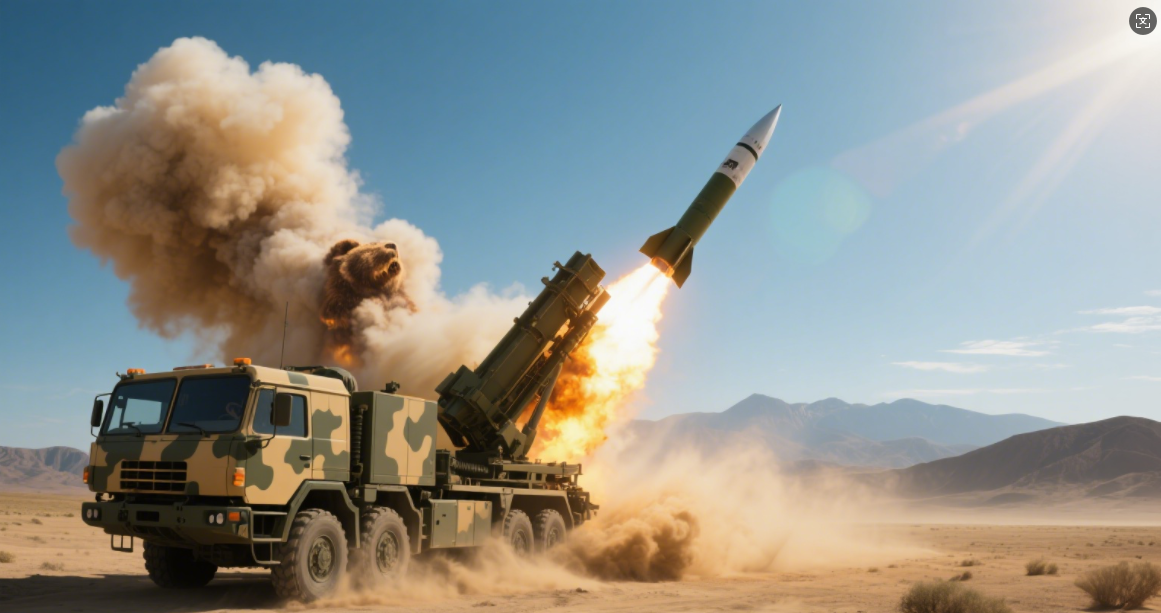
In modern warfare, precision strike capability is one of the key indicators for measuring military strength. Laser target designators are important equipment for improving missile strike accuracy. They emit coded laser pulses to provide accurate target indication for missiles, enabling missiles to hit targets accurately in complex battlefield environments.
System Components
The laser target designator system is mainly composed of a laser, a coding modulation module, an aiming and tracking module, a power module, and a communication interface module.
Laser
Laser can generate high-energy and highly directional laser beams, and is the core component of laser target designators. According to different application requirements, different types of lasers can be selected, such as neodymium-doped yttrium aluminum garnet (Nd:YAG) laser, which emits an invisible beam with a wavelength of 1064 nanometers, has high output power and good beam quality, and is suitable for long-distance target indication; eye-safe Er glass laser, which emits a laser with a wavelength of 1.54 microns, is less harmful to the human eye and is often used in occasions with high safety requirements, such as single-soldier portable laser target indicators.
Coding modulation module
The coding and modulation module encodes and modulates the laser beam emitted by the laser, giving the laser pulse specific identification information to prevent enemy interference and misjudgment. Our laser target designator has a total of 16 spaces, and 8 sets of codes will be pre-stored before delivery for testing. The other 8 sets of codes can be encoded by customers themselves.
Aiming and tracking module
The aiming and tracking module can achieve precise aiming and real-time tracking of the target. Through optical sights, electronic aiming systems, and image recognition technology, operators can quickly lock on to the target and use the servo control system to ensure that the laser beam is always on the target.
Power module
Provides a stable power supply for the entire laser target designator system. It can be powered by a variety of power supply methods, such as rechargeable batteries, fuel cells, or external power supplies. According to the actual use scenario, the appropriate power supply scheme can be selected to ensure that the equipment can continue to work in different environments for a long time.
Communication interface module
Realizes data communication between the laser target designator and the missile system and other combat platforms. Through standard communication protocols such as RS-422, Ethernet, etc., the target indication information is accurately transmitted to the missile, and control instructions and battlefield situation information from other platforms are received at the same time to achieve system coordination.
Target designator process
Target search and lock
The operator searches and locks the target in the battlefield environment through the aiming and tracking module of the laser target indicator. This process can be done by visual search using an optical sight or by using auxiliary detection equipment such as infrared thermal imaging and radar to find and lock the target at a long distance.
Laser irradiation and coded transmission
After locking the target, the laser emits a laser beam, encodes the laser pulse through the coding modulation module, and then emits the coded laser pulse to the target. The coded laser signal contains specific information about the target, such as the target type and location.
Missile reception and tracking
The semi-active laser seeker on the missile receives the laser-coded signal reflected by the target. The seeker calculates the position and motion information of the target based on the received laser signal strength, frequency and other parameters, and adjusts the flight attitude of the missile through the control system so that it flies along the direction of the laser beam reflected by the target until it hits the target.
Determination of key technical indicators
Action range
Determine the effective action range of the laser target indicator according to the combat range and actual application requirements of the missile system. Generally speaking, for long-range missile systems, the action range of the laser target indicator should reach several kilometers or even farther; for short-range missile systems, the action range can be appropriately shortened, but it must also meet the requirements of actual combat scenarios.
Accuracy indicators
In order to ensure that the missile can accurately hit the target, the aiming accuracy and tracking accuracy of the laser target indicator are crucial. Accuracy indicators are usually measured in terms of angle error to ensure that the laser beam can accurately illuminate the target and provide accurate target indication for the missile.
Laser output power
On the premise of ensuring sufficient reflection signal strength to the target, avoid excessive output power to cause safety hazards to operators and friendly forces. At the same time, the heat dissipation of the laser should be considered to ensure its stability under high-power continuous working conditions. Generally speaking, short-term irradiation (no more than 18 seconds) can be used for 8 measurements, and heat dissipation is required for 15-30 minutes. Different models and different energies have different corresponding times.
Reliability and stability
In complex battlefield environments, laser target indicators need to have high reliability and stability. We can adapt to harsh conditions such as -40 degrees Celsius to 55 degrees Celsius. Using high-quality components and advanced manufacturing processes, the system undergoes rigorous environmental testing and reliability verification to ensure that the equipment can work properly under various conditions.