
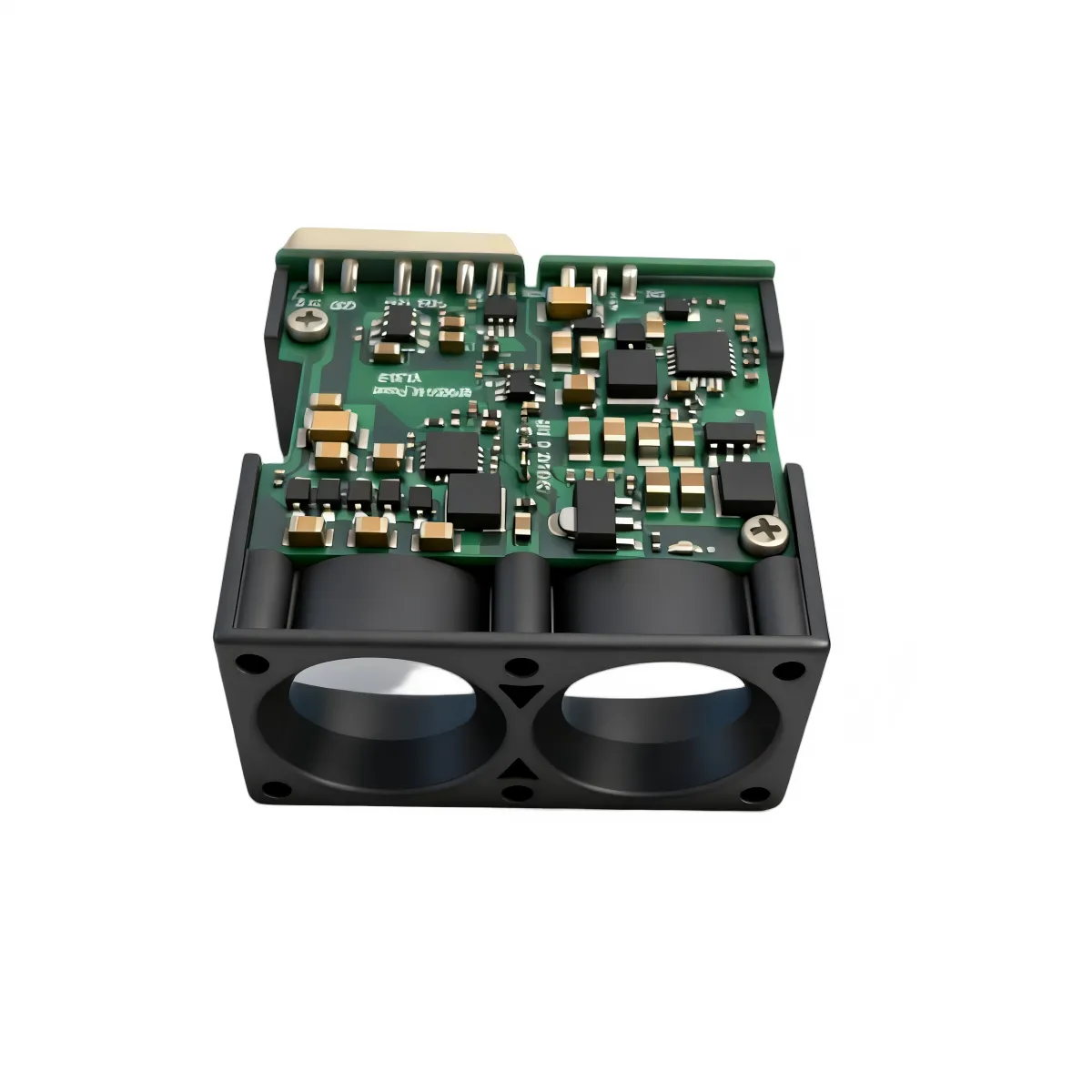
With applications such as drone food delivery, low-altitude logistics, and urban patrols, the low-altitude economy is moving from concept to large-scale operation. The laser ranging module, a core component supporting the safe flight and precise operations of these aircraft, is becoming increasingly crucial. To adapt to the complex needs of low-altitude scenarios, the laser ranging module is responsible for measuring distances, avoiding obstacles, and providing positioning and navigation.
Lightweight and miniaturized upgrades
Early laser rangefinder modules were bulky and heavy, impacting the flight time and maneuverability of small drones. Now, addressing the need for weight reduction in low-altitude aircraft, ERDI TECH has rigorously controlled the module's size and weight, keeping it between 50-300 grams. This has improved the drone's flight time. This upgrade isn't simply about miniaturization; it utilizes chip integration technology to consolidate previously scattered components, ensuring performance while reducing space requirements.
Enhanced anti-interference capability
Low-altitude flight faces complex environments such as reflections from tall city buildings, rainy weather, and strong sunlight. Previous laser ranging modules suffered from poor stability, misjudging distances when encountering glass curtain walls and experiencing data drift in rainy conditions. Now, by optimizing the laser wavelength and signal processing algorithms, the module can automatically filter out interference signals. For example, when delivery drones are used in heavy rain, the module can still accurately identify tree branches 50 meters away, with an error controlled within 1 centimeter, significantly improving flight safety.
Breakthrough in low power consumption and long battery life
Low-altitude logistics drones often need to fly continuously for several hours, placing extremely high demands on endurance and energy efficiency. In the past, laser ranging modules consumed a lot of power, but now, through low-power chips and intelligent sleep technology, they can automatically reduce energy consumption when not in use and output accurate data when in operation.
These technological innovations didn't appear out of thin air; they stemmed from the practical needs of the low-altitude economy. For drones to maneuver nimbly through narrow streets, smaller modules are required; for stable operation in complex weather conditions, stronger anti-interference capabilities are needed; and to improve operational efficiency, power consumption issues must be addressed. Conversely, upgrades to laser ranging modules enable low-altitude aircraft to handle a wider range of scenarios, from precise ranging in agricultural plant protection to obstacle detection in emergency rescue and targeted delivery in urban logistics.
It can be said that the low-altitude economy and laser ranging modules are mutually reinforcing. As low-altitude flight scenarios become more diverse, laser ranging modules will continue to evolve towards greater intelligence and reliability. These technological advancements will ultimately bring the low-altitude economy into more people's lives, making drone delivery and aerial inspections routine.