

1570nm RS422 Port Laser Rangefinder Module 20km LRF20E01ES
Need pricing or a tailored specification? Tell us your application — wavelength, range, platform and interface — and our engineers will reply within 24 hours with a proposal.
DESCRIPTION
The LRF20E01ES is a 1570nm eye-safe laser rangefinder powered by diode-pumped OPO technology. This advanced optoelectronic unit achieves refined integration of optical, mechanical and electronic assemblies.
Under standard visibility conditions, it attains an effective ranging range of no less than 20 km for large targets with reflectivity above 20%. When tracking a 2.3m × 2.3m target featuring identical reflectivity, the measurable distance reaches a minimum of 10 km.
It maintains stable ranging precision and is suitable for integration into vehicle-mounted, shipborne and portable optoelectronic observation systems.
TECHNICAL SPECIFICATIONS
|
Eye safety/level |
Class1/1M |
|
Laser Wavelength |
1570nm |
|
Ranging Capability |
≥20km (under standard visibility, large target, reflectivity ≥20%) ≥10km (under standard visibility, 2.3m*2.3m target, reflectivity ≥20%) |
|
Minimum Ranging Distance |
50m |
|
Ranging Accuracy |
≤1m(RMS) |
|
Ranging Frequency |
1~20Hz |
|
Accuracy rate |
≥98% |
|
Multi-target detection |
≥1. If more targets are needed, the communication protocol should be customized. |
|
Divergence Angle |
≤1mrad |
|
Dimensions (Length * Width * Height) |
≤220mm×116mm×131mm |
|
Weight |
≤3200g |
|
Power Supply |
28VDC±10% |
|
Power Consumption |
Average power consumption ≤30W Peak power consumption ≤100W |
|
Communication Interface |
RS422 |
|
Operating Temperature |
-40℃~+60℃ |
|
Storage Temperature |
-55℃~+70℃ |
|
Vibration and Shock |
Meeting the relevant requirements of GJB150.16A.2009 |
OUTLINE DIMENSION(mm)
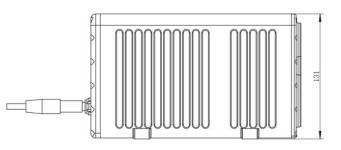
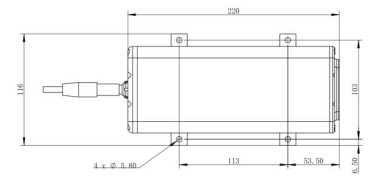
ELECTRICAL INTERFACE
The upper computer and this rangefinder are connected through an aviation connector, which is an electrical interface.
1. Power supply interface: DC26V to DC30V (28VDC recommended); average power consumption ≤30W, peak power ≤250W;
2. Communication interface: RS422.
Table 1 Electrical interface
|
Electrical Interface Diagram |
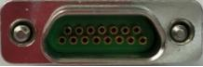 |
|
|
Pin |
interface definition |
note |
|
1~4 |
DC Power Supply |
+28V DC |
|
5~8 |
DC Power Supply Ground |
+28V Ground |
|
9 |
Serial Port T+ (Transmission + from Laser Rangefinder to Platform) |
RS422 |
|
10 |
Serial Port R- (Reception - from Platform to Laser Rangefinder) |
|
|
11 |
Serial Port T- (Transmission - from Laser Rangefinder to Platform) |
|
|
12 |
Serial Port R+ (Reception + from Platform to Laser Rangefinder) |
|
|
13 |
RS422 Communication GND (Optional, can be left unconnected) |
|
|
14 |
SYN+ 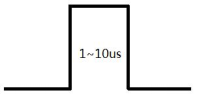 |
RS422 Differential External Time Synchronization |
|
15 |
SYN- 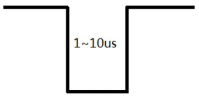 |
|
|
upper computer electrical interface |
J30J-15TJ with approx. 200 mm cable, supplied by the manufacturer |
|
APPLICATION NOTES
This 1570 nm eye-safe module delivers ≥20 km against large targets and ≥10 km against a 2.3 m × 2.3 m target, both at reflectivity ≥20% under standard visibility, with ≤1 m (RMS) accuracy, a 50 m minimum ranging distance and divergence ≤1 mrad. Its electrical profile is the parameter that shapes the mission: average consumption ≤30 W and peak ≤100 W on a 28 VDC ±10% supply is modest enough for platforms with limited generation headroom, and it is why the unit is described as suitable for vehicle-mounted, shipborne and portable optoelectronic observation systems — the installation classes covered by the site's pod and long-range observation material.
A 1–20 Hz ranging frequency with an accuracy rate ≥98%, external triggering with a laser-to-external-pulse synchronisation error no greater than 10 µs, and at least one detected target per shot support continuous measurement against moving subjects rather than a single reading. The ≤220 mm × 116 mm × 131 mm body at ≤3200 g with an RS422 interface and GJB150.16A.2009 vibration and shock compliance, operating from −40 °C to +60 °C and storing from −55 °C to +70 °C, is typically used where a stabilised mount has limited mass and power for the ranging channel.
SELECTION GUIDANCE
Select this model when a portable or vehicle-mounted observation head must provide eye-safe ranging to ≥20 km on large targets while drawing no more than ≤30 W average with a ≤100 W peak, and when ≤3200 g and a ≤220 × 116 × 131 mm envelope fit the mount. If the design already permits more mass and volume and requires longer reach or a 25 Hz ceiling, the higher-range units in the family are the appropriate step; if the head needs the smallest possible body, a lighter 1570 nm module should be compared first, accepting a lower maximum range. Note that the 1–20 Hz band, not 25 Hz, is what this unit offers.
Acceptance checks: Class 1/1M marking, ≥20 km on large targets and ≥10 km on a 2.3 m × 2.3 m target at reflectivity ≥20%, a 50 m minimum range, ≤1 m (RMS) accuracy, the 1–20 Hz frequency band, ≥98% accuracy rate and divergence ≤1 mrad. Verify the ≤10 µs external-trigger synchronisation error with the SYN+/SYN− pair in the J30J-15ZK pinout, ≥1 target per shot and any protocol customisation, the 28 VDC ±10% input, average ≤30 W and peak ≤100 W consumption, ≤3200 g mass, and the GJB150.16A.2009 vibration and shock evidence.
FREQUENTLY ASKED QUESTIONS
What is the ranging capability of the LRF20E01ES?
Under standard visibility the module reaches ≥20km for large targets with reflectivity ≥20%, and ≥10km for a 2.3m*2.3m target with reflectivity ≥20%.
What is the ranging accuracy of the LRF20E01ES?
Ranging accuracy is ≤1m(RMS), and the minimum ranging distance is 50m.
What is the ranging frequency of the LRF20E01ES?
Ranging frequency is 1~20Hz, with an accuracy rate of ≥98%.
What are the dimensions and weight of the LRF20E01ES?
Dimensions (length × width × height) are ≤220mm×116mm×131mm and the weight is ≤3200g.
What is the operating temperature range of the LRF20E01ES?
Operating temperature is -40℃~+60℃, with a storage temperature range of -55℃~+70℃.
ORDERING INFORMATION
Is there a minimum order quantity?
There is no minimum order quantity. Single units and evaluation samples are accepted.
What is the sample lead time?
Samples are shipped within 1 week after order confirmation.
What is the batch production lead time?
Batch production is delivered within 1 month after order confirmation.
RELATED TECHNICAL GUIDES
Further ERDI Laser engineering references on 1570 nm OPO eye-safe laser ranging modules:
- Comparison of 905nm, 1064nm and 1570nm ranging modules
- Analysis of the Core Differences between 1570nm and 1064nm Laser Ranging Modules
- Construction of the Optical Path System for a High-Stability 1570 nm OPO Laser Ranging Module
- Laser Rangefinder Module Platforms
- Laser Rangefinder Range Modeling
- How to Specify a Custom Laser Rangefinder Module: OEM Integration Guide
- Laser Ranging, Designation and OEM Integration FAQs

